The stakes are large. In Australia alone, brokers placed A$21.9 billion of general insurance premium in the six months to June 2026 (APRA), roughly A$44billion a year, most of it commercial. Even a 5% improvement on that base is worth more than A$2 billion a year to Australian insurance buyers.
Two of theworld’s largest brokers recently commented:
Aon reports that “clients that demonstrate high-quality underwriting data, strong engineering, and robust risk management practices are consistently achieving the most favorable outcomes,” and that “superior terms are available”where the insured can evidence its risk management “as part of a robust underwriting submission” (Aon, Global Insurance Market Insights, Q1 2026).Marsh advises that by “engaging early with insurers, businesses can negotiate better renewal terms and premiums” (Marsh Australia, 2026).
Every year, hundreds of thousands of mid-sized businesses around the world go through the same ritual. An insurance broker's renewal (or new cover) questionnaire arrives. Someone in the business with the fractional insurance manager role(often finance) starts chasing insurance and risk information through email, accounting systems, last year's spreadsheets and other disparate document storage areas. Often many weeks later, the information reaches the broker, often incomplete, severely restricting the insurance brokers ability to leverage the best insurance price and risk cover options, which in turn could lead to uninsured claims in the future.
It looks likean administrative nuisance. The evidence suggests it is something much moreexpensive. Underwriters price uncertainty, and a late, thin submission isuncertainty in its purest form. Visagio has been utilizing its extensivetechnology powered business transformation experience to develop an affordablesolution that makes the fractional insurance managers job much more efficientwhich in turn enables insurance brokers to provide improved insurance costs andcover options.

A typical insurance renewal?
One of the pilots, a professional services firm with a multi-line commercial programme, is typical of industry practice: one broker questionnaire, five insurer forms, and nobody whose job is insurance.
The broker's renewal pack arrived 66 days before expiry. Gathering and completing the information took more than seven weeks, leaving the broker just 13 days to work the market, against the roughly 90 days most practitioners consider necessary.Industry research suggests only 9% of insurance information packages arrive complete (Indio, 791 brokers).

The causes were common: end-of-financial-year work came first, the reviewing partner was on leave, the required insurance information figures were scattered across accounting reports, shared drives and desktops, and little from the prior year could be reused.
Cyber underwriters asked detailed questions about cross-border network connectivity.A wage declaration was blocked by an email security filter. Overlaps between cyber and management liability cover took further rounds of clarification.
The friction did not stop at binding. Certificates of currency could not be issued until cover was confirmed, right against the expiry of state government supplier portal registrations. One certificate omitted a cover the portal required, which meant requesting interim confirmations.
Insurance management is often a fractionaljob
That experience is typical because of who actually manages insurance in most businesses. Large corporates employ risk managers (and even less dedicated insurance managers)and buy enterprise risk software. Below this sits the far more numerous mid-market: businesses large enough to need a multi-line commercial programme placed by a broker, but too small to have anyone whose dedicated job is insurance.

In these businesses, insurance is a fraction of someone's role. It falls to the CFO, the financial controller or an office manager, alongside payroll, month-end and everything else.
• Mid-market firms typically hand insurance to theCFO rather than a risk manager (Business Insurance).
• 90% of Australian SMEs have no formal risk plan(Vero 2026), and only 42% review sums insured every year (Vero 2025).
A fractional insurance manager owner more often has no system, no institutional memory and no protected time. The work arrives once a year, competes with whatever else is urgent, and is largely rebuilt from scratch each time.
Insurance brokers: time in the market isleverage
Brokers are clear that quality risk and insurance information well in advance of renewal is what lets them do their job. A renewal guide from Winter-Dent & Co. makes the point that arriving 60 days out with organised documentation “creates competitive tension”, because “underwriters reward preparation they can verify.”
“If we really want to market this program aggressively and achieve the best result for our client, we need to start early.”
— HUB International, Insurance Business,September 2026
Leading US brokers often now begin renewals 120 to 150 days before expiry. The reality on the client side looks very different:
• Only 9% of commercial applications reach the broker complete and market-ready; over 90% need manual back-and-forth (Indio, 791 brokers).
• In Australia, about half of the 5,417 broker Code breaches recorded in 2025 were renewal failures, including 603 failures to advise on options. Brokers attributed them to “manual error, system limitations and resourcing pressures during peak periods” (IBCCC).
• 55% of broker errors and omissions claims allege a failure to obtain adequate cover (Victor Insurance Canada).
When the information arrives 13 days out, the broker has little choice but to roll the programme over with the incumbent. The buyer loses the competition, thereby compromising cost and cover and the broker carries the compliance and liability risk.
Insurance underwriters: incomplete submissions get priced, or ignored
From the underwriter's desk, the problem shows up as poor submissions:
• More than 70% of commercial submissions are incomplete or inconsistent, and about 60% are never quoted (CanadianUnderwriter, July 2026).
• UK underwriters report that 40–50% of submissions are incomplete and that they spend over half their time chasing data (Intelligent AI, 2026).
• Underwriters spend about 40% of their time on administration and only 30% actually underwriting (Accenture).
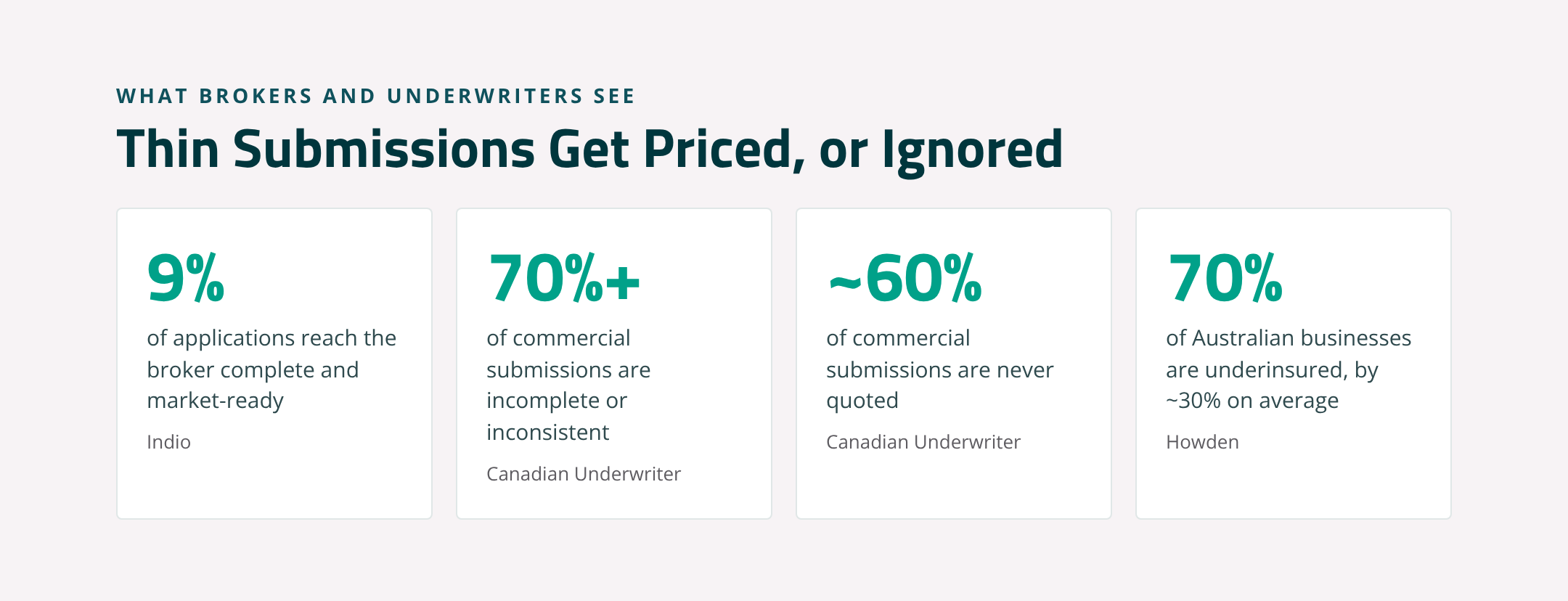
What brokers and underwriters see on the other side of the renewal.
What happens to a thin submission is predictable. Australian underwriting agencies say underwriters “often assume the worst” when data is thin (Insurance Business Australia, Aug 2025). Convr is blunter: “poor submissions invite conservative assumptions, higher pricing, restrictive terms, or a decline.”
The market is rewarding the opposite. Aon notes that businesses “with strong risk data…and well-prepared insurance submissions are more likely to achieve favourable outcomes at renewal.” With Pacific commercial rates falling in 2026, the reductions are flowing to data-rich risks first.
There is also a quieter cost. When the same figure is typed by hand into multiple insurance forms, inconsistencies creep in. Under section 28 of Australia's InsuranceContracts Act, a misstated fact can give an insurer grounds to reduce a claim.
What we have been testing
The question we set ourselves was simple: could affordable technology give a fractional insurance owner the discipline and functionality of a full-time (insurance)risk function, thereby reducing administration costs and increasing the potential for lower premium costs and better insurance risk cover matching.
Insurance Manager, the platform being developed and tested across pilots, sits on the buyer's side of the renewal. The aim is to get complete, consistent and evidenced information to the broker by day −90, every year. Early findings point to a few principles that matter more than any single feature:
• Start before the broker asks. Stablefacts can be confirmed well before EOFY gets in the way.
• Ask once, use many times. Each figure is requested once from the right person and reused across every form.
• Keep the record. Every answer linked to its source, so next year starts from this year rather than from scratch.
• Reduce contract risk insurance gaps: A central insurance repository enables automated insurance to contract exposure pre-screening.
These are the outcomes we are designing for and testing in the pilots:
• Time back for the broker. In the pilot renewal above, more than seven weeks went on gathering and completing information. With stable facts held year-round and each figure requested only once, the target is about two weeks of effort, with the submission in the broker’s hands by day −90. That turns 13 days of market time into as much as90.
• Data quality. One source for every figure means the same number appears identically on every insurer form, with evidence attached and gaps flagged before the broker sees the pack. The target is a complete, market-ready submission on first send, against an industry norm of just 9%.
• Less back-and-forth. Fewer clarification rounds for the broker and the underwriter, and certificates of currency issued on time rather than chased against supplier deadlines.
The cost of the insurance administrationburden
Commercial insurance procurement is usually discussed in terms of markets, rates and capacity. Far less attention goes to the weeks before the broker ever approaches an underwriter. Yet that is where much of the outcome can be decided: by whether a busy finance team, doing insurance as a fraction of its job, can assemble good information in time.
Buyers pay for the uncertainty. Brokers lose the time they need to create competition.Underwriters spend their days chasing data instead of underwriting.
Sizing the prize
How does more time for the broker, and earlier, better information for the underwriter, translate into dollars? Through three levers: better designed insurance programs for specific risk profiles (reducing the cost of over-insurance as well as underinsurance), more insurers considering the risk, and less of the premium loaded for uncertainty.
For an individual business spending A$500,000 a year on premium, a 5–10% improvement is worth A$25,000–50,000 every year, that flows straight through to the bottom line. That is before counting broader cover, restored limits and lower deductibles, which are often where well-prepared buyers gain the most. Repeat that across every renewal market in the world, and the problem quickly runs to billions of dollars.

We would like to hear from others who live this every year. If you manage insurance alongside another role, how far ahead of renewal does your broker receive your information? And if you are a broker or underwriter, what would a quality submission at day −90 change for you?
To learn more about how Visagio helps organisations improve procurement, supply chains and risk, visitvisagio.com/en.
Sources
• APRA,Intermediated general insurance statistics, six months to June 2026 (via Insurance Business, 29 Sep 2026)
• Aon, Global Insurance Market Insights, Q1 2026
• Marsh Australia,Australian mid-year insurance market update 2026
• Indio (AppliedSystems), State of Insurance Renewals (2021)
• Business Insurance, Mid-market buyers need a rigorous review process for renewals
• Vero SME Insurance Index 2025 and 2026
• Winter-Dent &Co., How to prepare for your commercial insurance renewal: start 120 days out
• Insurance Business, The 30-day renewal is dead: why brokers are starting earlier than ever (HUB International, Trucordia), 9 Sep 2026
• Insurance BusinessAustralia, IBCCC puts renewal failures at centre of 2025 breach data (Jun 2026)
• Victor Insurance Canada, E&O for insurance brokers: risk analysis
• Canadian Underwriter, Handbook: what makes a great submission (Jul 2026)
• Intelligent AI,The Risk Intelligence Gap (UK underwriting research, via Insurtech Insights, 12May 2026)
• Accenture, Why underwriters don’t underwrite much
• Howden, What is underinsurance? (Matt Bacon, CEO Howden Pacific, Aug 2025)
• Insurance Business Australia, What brokers get wrong in submissions to underwriters (19 Aug 2025)
• Convr, What makesa high-quality insurance submission
• Aon, GlobalInsurance Market Overview, Q2 2026
• InsuranceContracts Act 1984 (Cth), s28