
The frontier gets the headlines, but it isn't the pattern winning inside enterprises. Since the dawn ofGenerative AI (GenAI or just AI for short in the context of this article), the story has been “bigger is better”: the largest model, the longest context, accessed through someone else's API. It made for good demos. It has also left many organisations with AI tools that are expensive to run, hard to control, and dependent on infrastructure they neither own nor understand.
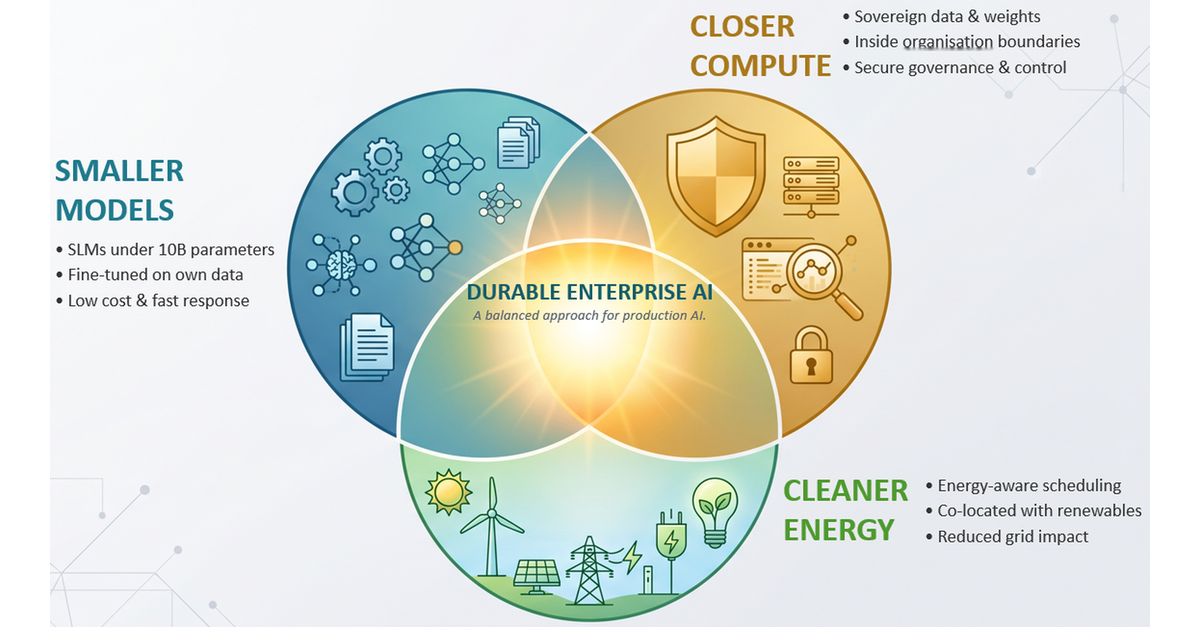
A quieter, more durable pattern is emerging among teams putting AI into production. The models are smaller, sized to the job rather than the benchmark. The compute is closer, kept where the organisation can see and govern it. And the whole thing is cleaner, run in a way that doesn't strain the power it depends on. Smaller, closer, cleaner is not a compromise on ambition. For most enterprise work, it is the more serious version of it.
This article is about the approach at the heart of this shift: Small Language Models (SLMs). An SLM is a compact, task-specific model fine-tuned on your own data and small enough torun yourself, unlike a general-purpose large language model (LLM) reached through an API.
01 Smaller: not every problem needs a genius
The instinct to reach for the largest model is understandable, and frontier models are remarkable at open-ended work. But most enterprise tasks are not open-ended. Classifying a document, extracting fields from a form, routing a query, summarising a case note: these are high-volume, bounded problems where a frontier model is expensive overkill.
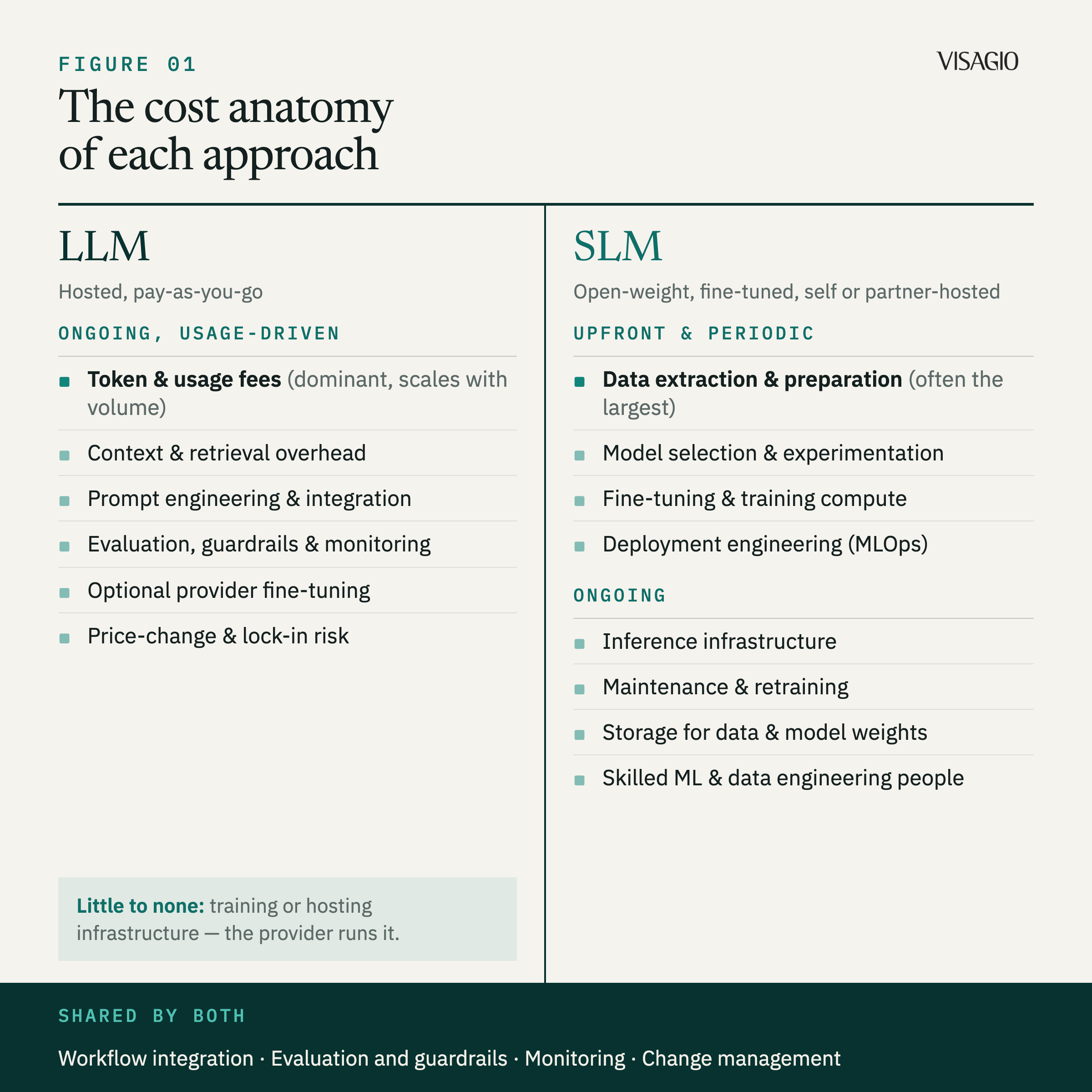
And the expense is the part that catches teams out. Prices for a given level of capability are collapsing:the cost of GPT-3.5-level performance fell more than 280-fold in about 18months, according to Stanford's 2025 AI Index. Yet total spend keeps climbing, as enterprise AI spend more than tripled to around US$37 billion in 2025 (MenloVentures). Cheaper tokens simply get consumed in far greater volume, especially as retrieval-heavy and layered agentic workflows can burn tens of thousands of tokens per request. In production, token consumption, not licence fees, is becoming the dominant ongoing cost of enterprise AI.
This is why model choice should be a use-case decision, not a default. A Small Language Model(SLM), typically under about 10 billion parameters and fine-tuned on your own data, will often match or beat a general-purpose giant of hundreds of billions of parameters on the narrow task you care about. NVIDIA researchers found small models can be 10 to 30 times cheaper to serve for the repetitive, well-structured calls that make up most agentic work. Reserve frontier LLMs for the genuinely hard, high-variety work, and use right-sized models for the high-volume, bounded tasks that fill most of the day.
What makes this practical now is that the open-weight field has matured. Models you can download, fine-tune and own outright, such as Meta's Llama, Microsoft's Phi,Google's Gemma, Alibaba's Qwen and Mistral, are close enough to frontier quality for most tasks, several under permissive licences for commercial use.The barrier to owning a capable, purpose-built model has fallen sharply, and with it the argument for renting one for everything.
02 Closer:sovereignty is now a board-level requirement
“Sovereign AI” is usually discussed at the level of nations. The more immediate version is on enterprise risk registers: do we control our own AI? It has three layers. Your data, which shouldn't leave your environment to be logged or used as training fodder elsewhere. Your model, where owning the weights means your capability can't be deprecated, repriced or restricted out from under you And your compute, the location and jurisdiction where the work runs.
For regulated industries, government and critical infrastructure, these are not abstract concerns; they are increasingly the difference between an initiative that clears risk and compliance and one that stalls in review. And it becomes achievable for the same reason as the cost argument: once your models are small enough to own and run yourself, keeping data, weights and compute inside your own boundary becomes a straightforward design choice.

03 Cleaner: a constraint worth designing around
There is a third factor, and it is physical. AI's energy demand is growing quickly enough that power and grid access, not just chips, are becoming a real constraint. Smaller models help here too: a right-sized model draws a fraction of the energy of an oversized one, and where and when compute runs increasingly matters. It is worth designing around rather than discovering later.
04 Why these three are converging now
Individually, each has been true for a while. What's new is that they are landing together and reinforcing each other. Open weights make smaller models own able. Own able models make sovereignty affordable. Affordable sovereignty means you decide where and how your compute runs. Pull one thread and the others follow.
This is not theory for us. At Visagio we are walking the walk: training several Small Language Models on our own internal data and building frameworks that quantify theLLM-versus-SLM trade-off, putting real numbers to the cost, quality and latency of each option. It is also why we've partnered with Project Ohm, a Perth-based venture building energy-aware, sovereign GPU compute, to explore where these models run.
Open weights → own able models → affordable sovereignty → compute on your terms.
05 The real question
The temptation is to keep asking “which model is best?” The more useful question is “what is the smallest, most controllable and most cost-effective way to solve this problem well?”
That reframing producesAI that is cheaper to run, easier to govern and more defensible to the people who sign off on it.
The organisations that lead the AI adoption journey won't be the ones consuming the most compute or tokens. They'll be the ones who matched the model to the task, kept it close enough to control, and paid only for the capability they needed.
What about you? Is yourAI strategy still anchored to the largest available model, or are you starting to size it, cost it and control it deliberately? I'd be interested in how others are weighing this up.
SOURCES
● StanfordUniversity HAI (2025). The 2025 AI Index Report (inference cost). https://hai.stanford.edu/ai-index/2025-ai-index-report/research-and-development
● Menlo Ventures (2025). TheState of Generative AI in the Enterprise. https://menlovc.com/perspective/2025-the-state-of-generative-ai-in-the-enterprise/
● Belcak, P. et al. (2025).Small Language Models are the Future of Agentic AI. NVIDIA Research,arXiv:2506.02153. https://arxiv.org/abs/2506.02153
● International Energy Agency(2025). Energy and AI. https://www.iea.org/reports/energy-and-ai/executive-summary
● Hugging Face (2026). BestOpen-Source LLM Models in 2026. https://huggingface.co/blog/daya-shankar/open-source-llms
● BentoML (2026). The BestOpen-Source Small Language Models (SLMs) in 2026. https://www.bentoml.com/blog/the-best-open-source-small-language-models
ABOUT THE AUTHOR
Luan Mai is a Partner at Visagio and leader of VLabs, its AI and advanced analytics business unit. He holds a PhD in mathematical programming optimisation and has spent 15+ years applying AI and advanced analytics to the resources and infrastructure sectors.


.png)